
Japanese Sake Cups - Tokyo 1945
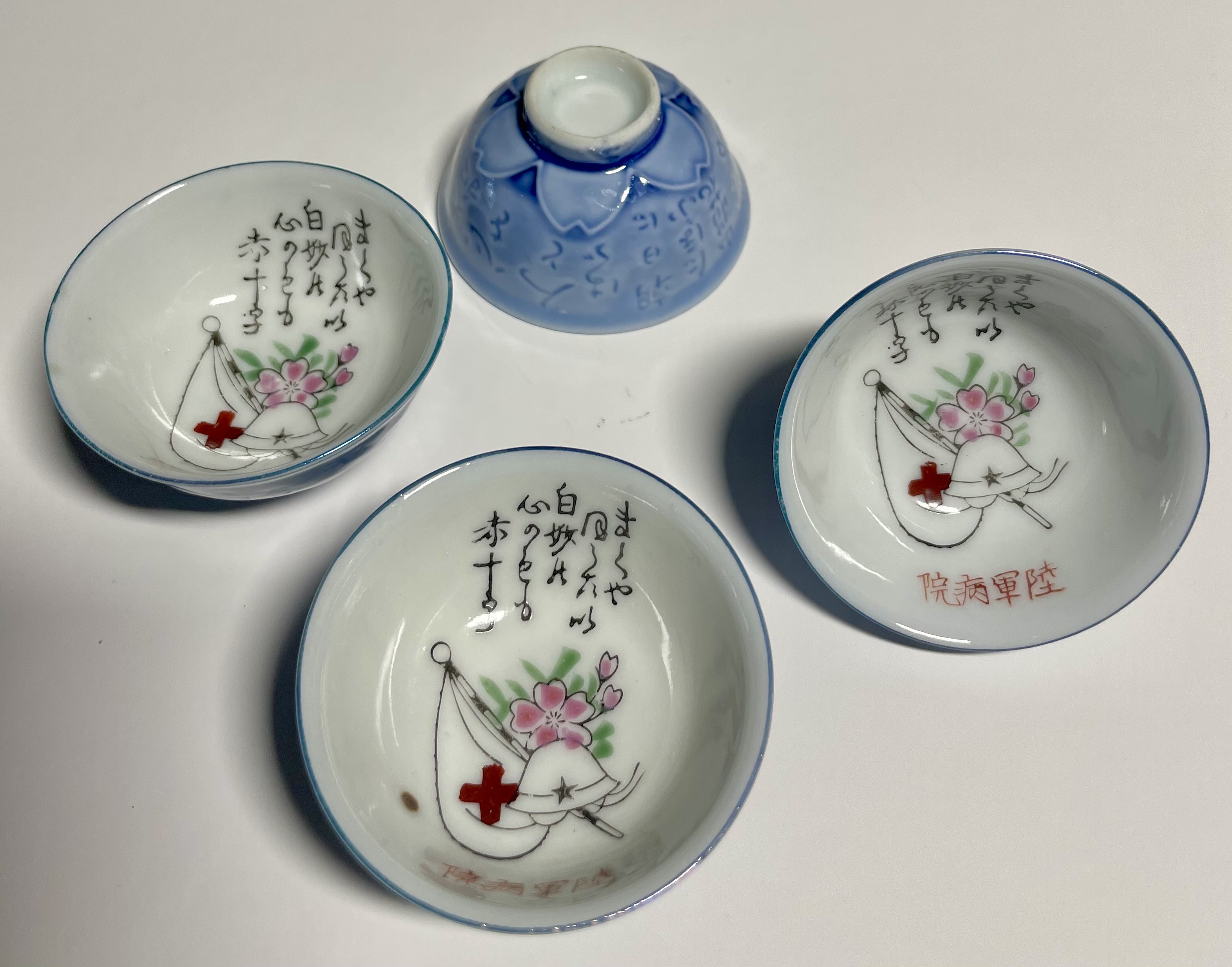
The Japanese writing on the sake cups (sakazuki) translates to:
Top black text (around the rim): “花は桜木人は武士” (Hana wa sakuragi, hito wa bushi)
Literal: “Among flowers, the cherry blossom; among men, the warrior.”
Meaning: A classic Japanese proverb praising the cherry blossom as the finest flower (beautiful but short-lived, like the samurai ideal) and the warrior (bushi/samurai) as the finest man. It embodies bushido values of loyalty, bravery, and accepting a brief life.
Bottom red text: “陸軍病院” (Rikugun Byōin)
Translation: “Army Hospital”
The design: The illustration shows a military helmet with cherry blossoms (sakura) on top and a red cross symbol (likely representing medical service or the Japanese Red Cross Society, which supported the military).
This is a classic Imperial Japanese Army hospital commemorative sake cup from the WWII era (1937–1945). These were common souvenirs for soldiers, medics, or patients—often given upon discharge, recovery, or demobilization. The proverb ties to samurai honor, while the red cross and “Army Hospital” mark it as from a military medical unit.
My grandfather likely picked them up as a black-market or street-vendor keepsake during his week in Tokyo. They are a beautiful, poignant piece of history!
History & Type of My Grandfather’s Nagagi (Kimono)
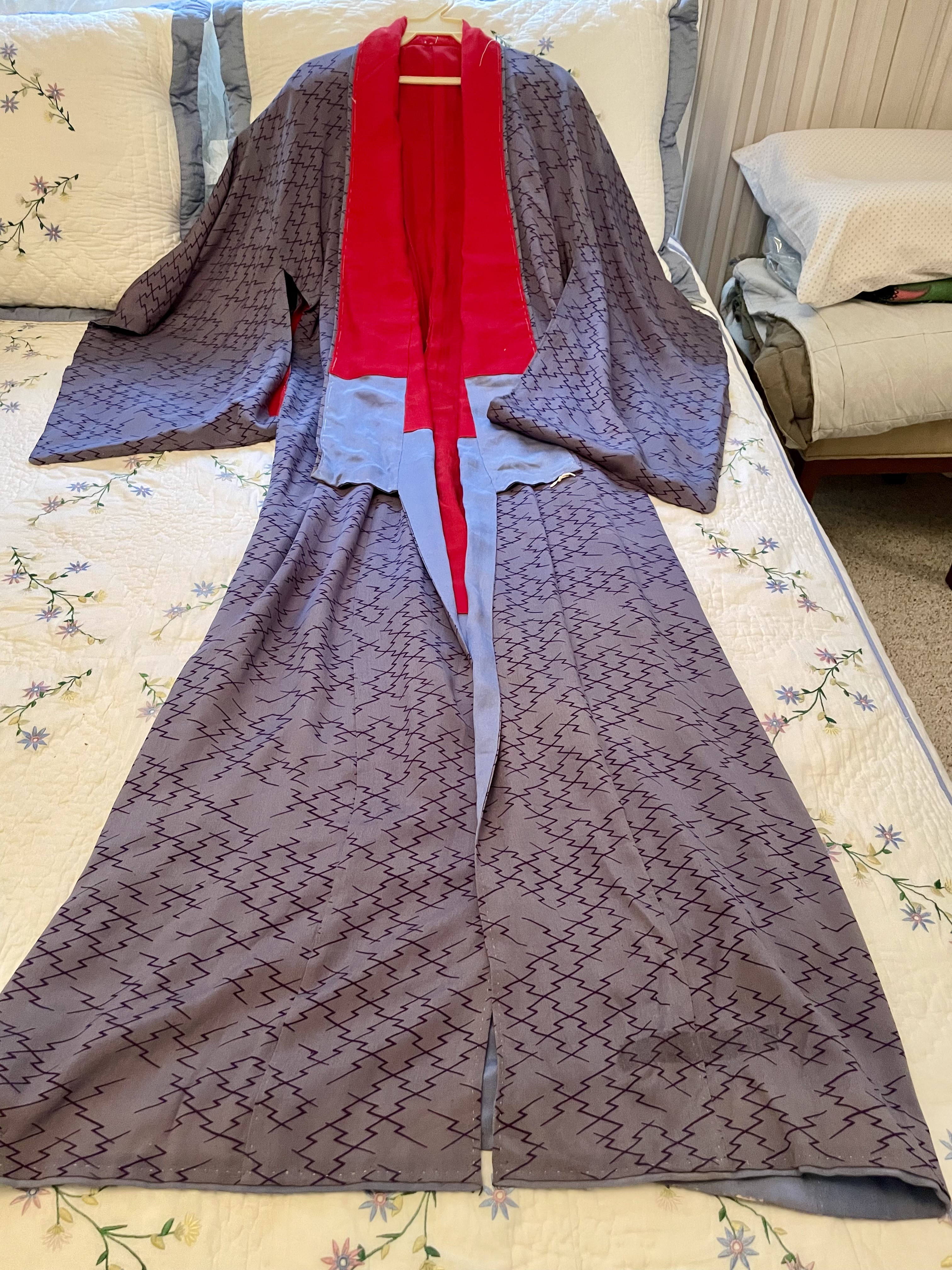
This is a classic men’s nagagi (長着), the full-length under-kimono worn by men (and women) as the base layer— from the late 1930s to mid-1940s.
Historical Context (1945 Tokyo)
By December 1945, silk clothing was scarce in Japan — most had been requisitioned for parachutes or uniforms years earlier. What remained was pre-war stock or family heirlooms sold on the street to survive. GIs loved them as “smoking jackets” or robes back home because they were lightweight, luxurious, and looked exotic without being flashy.
Identification & Details
- Type: Men’s nagagi (sometimes called just “kimono” in English, but technically the long under-robe).
- Era: Late 1930s to mid-1940s (Showa period) — the fabric, cut, and subtle pattern scream wartime/pre-occupation Japan.
- Pattern: Dark charcoal-gray silk with a repeating sayagata ( interlocking manji/swastika motif) — an ancient Buddhist symbol for eternity and good fortune, extremely common on men’s formal and everyday kimonos before and during the war (no Nazi connection in Japan).
- Lining: Bright red silk collar lining with light blue lower lining — classic men’s style: subdued outside, flash of color inside.
- Construction: Hand-stitched, wide sleeves, straight cut, no family crest — this would have been everyday or semi-formal wear for a middle-class Tokyo salaryman or minor official.
Why Mel Brought This One Home
- Practical souvenir: Folds to the size of a towel, weighs almost nothing — perfect for a duffel already stuffed with pearls and lacquer.
- Masculine & understated: No bright flowers or cranes (typical women’s patterns) — this was a man’s robe, something he could actually wear as a smoking jacket back in Indiana without looking flashy.
- Black-market classic: In December 1945, silk nagagi like this were among the most common high-value items families sold to survive. A good one cost 2–4 cartons of cigarettes — exactly the kind of “treasure” Mel and Bob were hunting.